

The #1 Reason Students Fail O-Level Chemistry (and It’s Not the Mole Concept)
Many students believe that the most difficult part of O-Level Chemistry is the Mole Concept. While it can be challenging, the real reason many students struggle is a lack of understanding of fundamental concepts.
Ask any Singapore parent why their child is struggling with O-Level Chemistry and you will hear the same answer every time: the mole concept. Ask any O-Level Chemistry tutor in Singapore the same question and you will get a very different answer.
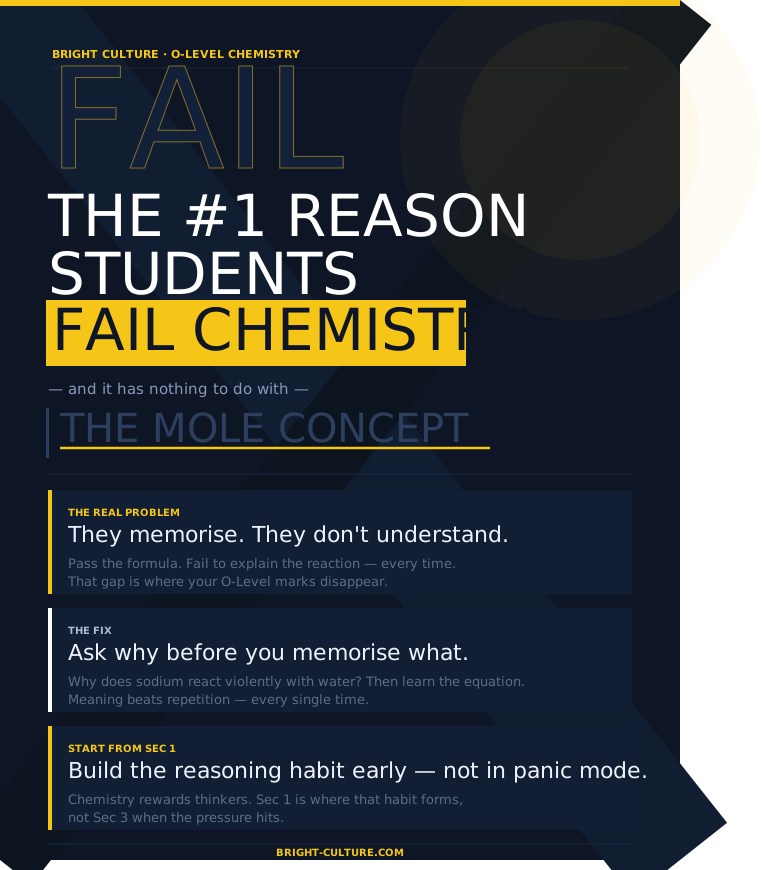
What Most People Think the Problem Is
The mole concept has a reputation. Parents dread it. Students panic when they see it on the syllabus. Tutors spend entire lessons on it. And because it arrives in Sec 3 and feels impossibly abstract, it becomes the villain of every Chemistry struggle story.
But here is what actually happens in most O-Level Chemistry papers. A student who understands the mole concept perfectly can still fail. And a student who is shaky on mole calculations can still pass — because the exam tests far more than one topic.
The mole concept is a symptom of the real problem, not the cause. And until that real problem is identified and fixed, no amount of mole concept drilling will move the needle.
Recognizing the real problem is the first step toward improvement. With the right study strategies, consistent practice, and a positive mindset, students can overcome their difficulties and achieve success in O-Level Chemistry.
The Real #1 Reason: Conceptual Gaps Left Unaddressed Since Lower Secondary
The single biggest reason students fail O-Level Chemistry in Singapore is this — they have accumulated conceptual gaps since Sec 1 and Sec 2 that were never properly closed.
Chemistry is a subject built entirely on itself. Every new topic assumes understanding of what came before. Atomic structure leads to bonding. Bonding leads to properties of substances. Properties of substances lead to reactivity. Reactivity leads to the mole concept. The mole concept leads to electrolysis and organic chemistry.
When a student memorizes their way through Sec 1 and Sec 2 Chemistry — passing tests by recalling definitions without truly understanding the underlying concepts — they build their O-Level foundation on sand. The structure holds until Sec 3, when the content becomes too complex and interconnected for surface-level understanding to carry them any further.
By the time a parent notices the problem, the student is already in Sec 3 or Sec 4, panicking about the mole concept, when the real gap is three topics earlier. This is why so many students say: “I study Chemistry for hours but nothing goes in.” The new content cannot find anything solid to attach to.
The 3 Lower Secondary Chemistry Gaps That Cause O-Level Failure
1. Atomic Structure and the Periodic Table
Most Sec 1 students memorize the periodic table layout and the definitions of protons, neutrons and electrons. Very few actually understand what atomic structure means for the way substances behave. If your child cannot explain why sodium is reactive and argon is not — using the language of electron shells and stability — they have a gap that will show up in bonding, reactivity series and electrochemistry at O-Level.
2. Chemical Bonding
Ionic bonding, covalent bonding and metallic bonding are introduced in lower secondary and returned to repeatedly at O-Level. Students who memorize “ionic bonds involve transfer of electrons” without understanding why that transfer happens, and what it means for the properties of the compound, will struggle every single time bonding appears in an exam question — which is often.
3. Chemical Equations and Formulae
Writing and balancing chemical equations is a skill that runs through the entire O-Level Chemistry syllabus. Students who are shaky on formulae and equation balancing in Sec 2 will find the mole concept, electrolysis, and organic chemistry significantly harder — not because those topics are harder, but because the notational language of Chemistry is unfamiliar to them. They are trying to understand the content and decode the language at the same time.
Why This Problem Is So Hard for Parents to See
Sec 1 and Sec 2 Chemistry grades often do not reveal this problem clearly. Tests at lower secondary level tend to reward recall — definitions, diagrams, matching questions. A student can score 65 to 75 percent on these tests while understanding very little of the underlying concepts.
Parents see a passing grade and assume Chemistry is under control. The student feels okay because the tests feel manageable. Then Sec 3 arrives and everything changes at once — new topics, more math’s, deeper questions — and the conceptual gaps that were invisible suddenly become impossible to ignore.
This is the most common pattern that O-Level Chemistry tutors in Singapore see. Not a student who suddenly became bad at Chemistry in Sec 3. A student who was never building real understanding from the start.
What Good O-Level Chemistry Tuition in Singapore Actually Fixes
The best O-Level Chemistry tuition in Singapore does not start with whatever topic the student is currently covering in school. It starts with a diagnostic — a structured review of the foundational concepts from lower secondary to identify exactly where the gaps are.
Once the gaps are identified, tuition works backwards and forwards at the same time. Filling the lower secondary gaps while keeping pace with the Sec 3 and Sec 4 syllabus requires careful sequencing — and it is exactly this kind of structured, personalized approach that separates effective Chemistry tuition from simply re-teaching school content.
For students who are already in Sec 4, this process is more compressed but still possible. The focus shifts to the highest-yield foundational gaps — the ones that are causing the most damage across the most topics — and addresses those first. Eight to twelve weeks of focused, well-sequenced Chemistry tuition can produce significant grade movement even at this stage, provided the root cause is being targeted rather than just the surface symptoms.
What Parents Should Do Right Now
If your child is in Sec 1 or Sec 2, the most valuable thing you can do is not wait. Chemistry difficulty does not announce itself clearly until Sec 3 — by which point the gap is already wide and time is already short. Building genuine conceptual understanding early is significantly less stressful and less expensive than emergency intervention in Sec 4.
If your child is already in Sec 3 or Sec 4 and struggling, stop focusing exclusively on the mole concept. Ask their teacher or tutor: where exactly did the understanding break down? What is the earliest topic where they stop being able to explain things in their own words? That is where the work needs to start.
The mole concept is not the enemy. Unaddressed conceptual gaps are. And those gaps, once found, can be closed — with the right support, at the right time.
Book a free trial O-Level Chemistry class today — available online and at our Novena centre — and let us identify exactly where your child’s Chemistry foundation needs strengthening.


