

Biology is Not About Memorizing — Here’s the Right Way to Study It from Sec 1
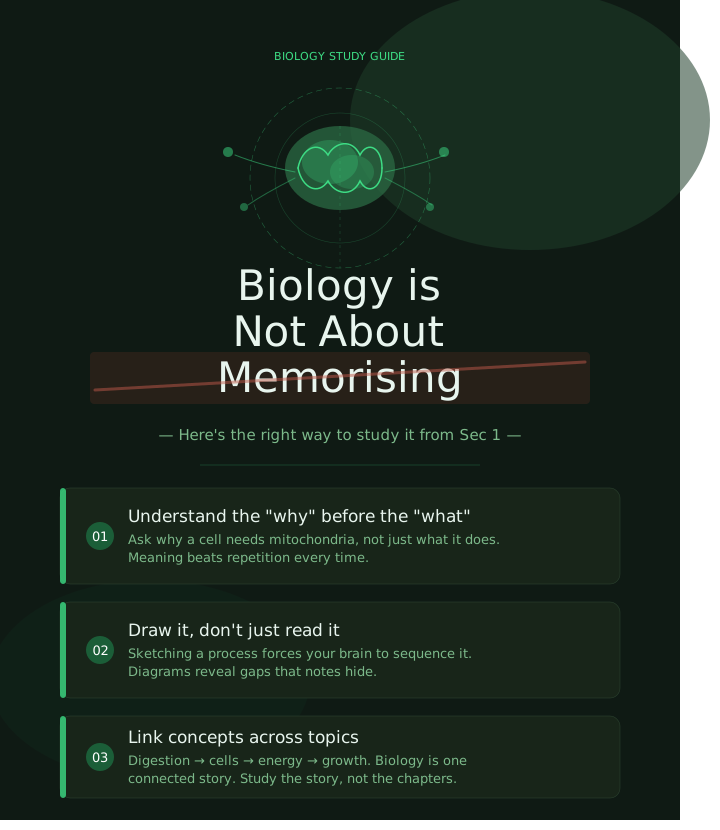
Sec 1 Biology tuition Singapore
Every Sec 1 student in Singapore does the same thing when Biology homework comes around. They open the textbook. They read the chapter. They highlight the key terms. They close the book and hope it sticks.
Then the test arrives — and the questions look nothing like what they memorized.
If this sounds familiar, you are not watching your child fail Biology. You are watching them use the wrong method for the wrong subject. Biology is not a memorization subject. It never was. And the sooner your child understands that, the faster their results will change.
Why Re-Reading Does Not Work for Biology (Even Though It Feels Productive)
Here is the uncomfortable truth about re-reading: it creates the illusion of learning without the reality of it.
When your child reads a Biology chapter and thinks, “yes, I understand this,” what they are actually experiencing is recognition — the feeling of familiarity. Recognition is not the same as being able to retrieve and apply information under exam conditions.
Sec 1 Biology tuition Singapore secondary school is built around processes. Photosynthesis is not a fact to remember — it is a sequence of events with inputs, outputs, conditions, and consequences. Digestion is not a list of organs — it is a system where each part affects the next. The moment a question changes the context or asks “explain why,” pure memorization collapses.
Re-reading fills the brain with words. Biology exams test what students can do with those words.
The Difference Between Memorizing Facts and Understanding Processes
This is the most important shift a Sec 1 Biology student can make — and most students never make it because no one explains it to them directly.
Memorizing a fact looks like this: “Chlorophyll absorbs sunlight.”
Understanding a process looks like this: “Chlorophyll in the leaf absorbs sunlight, which provides the energy needed to convert carbon dioxide and water into glucose and oxygen. Without sufficient light, this process slows down and the plant cannot produce enough food to grow.”
Both students might score the same on a fill-in-the-blank question. But in an O-Level Biology paper — or even a Sec 1 mid-year exam — only the second student can answer: “A plant was placed in a dark room for 48 hours. Explain what would happen to its glucose stores and why.”
The difference is not intelligence. It is method.
Process-based understanding means your child can trace cause and effect, explain relationships between structures and functions, and answer questions they have never seen before. This is exactly what Singapore Biology examinations — at every level — are designed to test.
3 Biology Study Methods That Actually Transfer to Exam Questions
1. Concept Mapping
Instead of listing facts in a linear outline, concept mapping asks students to draw the relationships between ideas. Start with a central concept — say, “cell” — and branch outward: what does a cell contain, what does each part do, how do animal and plant cells differ, how do cells relate to tissues and organs?
This is not busywork. It forces the brain to make connections, which is exactly what Biology questions demand. A student who has mapped the relationship between the digestive system and the circulatory system can answer transfer questions far more reliably than one who has memorized both systems separately.
To start, your child needs only a blank piece of paper and a pencil. Draw the main topic in the Centre. Ask: what connects to this? What does this affect? What does this depend on? Keep going until the connections run out. Then study the gaps.
2. The “Explain It Out Loud” Method
After reading a section, your child should close the textbook and explain what they just read — out loud, as if teaching someone else.
This technique, sometimes called the Feynman method, is extraordinarily effective for Biology because it immediately reveals the difference between vague familiarity and genuine understanding. If your child can explain osmosis clearly without looking at their notes, they understand it. If they use filler words like “somehow” and “and then it just happens,” they have a gap.
This works at home with no special materials. Parents do not need to understand Biology themselves — they just need to listen and ask: “But why does that happen?” and “What would happen if that step was missing?”
3. Active Recall With Targeted Questions
Instead of reading notes again, your child should write down five to ten questions based on what they just studied — then answer those questions the next day without looking at their notes first.
For Sec 1 Biology tuition Singapore tutors use this method because it mirrors exam conditions. The retrieval effort is what builds long-term memory. The discomfort of not remembering something immediately is not a sign of failure — it is the learning happening.
Good question types for Biology active recall include: “What is the function of X?”, “Compare X and Y”, “Explain what happens when Z is removed”, and “Give two reasons why…”
What Lower Secondary Biology Is Really Testing
Many parents assume that Sec 1 and Sec 2 Biology is preparation for O-Levels — a relaxed runway before things get serious. This is a costly misunderstanding.
The topics covered in lower secondary Biology — cells, organization, nutrition, transport, respiration — are the exact foundations that O-Level Biology builds on in Sec 3 and Sec 4. A student who memorizes their way through Sec 1 will hit a wall the moment the Sec 3 content arrives, because the new content assumes understanding, not recall, of everything that came before.
What lower secondary Biology is really testing is the ability to read a scenario and explain it using biological reasoning. Even in Sec 1 exams, questions include phrases like “suggest a reason why,” “explain how,” and “compare the effect of.” These are not memory questions. They are thinking questions — dressed up in Biology language.
The students who do well are not necessarily the ones who study the most. They are the ones who study correctly.
How to Shift From Memorisation to Understanding — Starting This Week
The shift does not have to be dramatic. Here are three immediate changes your child can make:
First, after every Biology lesson, spend ten minutes writing down the main process covered — not the facts, but the sequence and the reasons. “This happens, which causes that, because…”
Second, when revising, always ask “why” and “what if” after every statement. “Mitochondria produce energy — why does the cell need energy? What happens to a cell that doesn’t have enough?”
Third, use the textbook diagrams actively. Cover the labels, point to a structure, and try to name it and explain its function from memory. Then check. This builds both recall and understanding at the same time.
These habits take slightly longer than passive reading. But they produce results that passive reading never will.
The Right Support Makes the Method Stick
Understanding the right approach to Biology is one thing. Consistently applying it — especially when school is busy, exams are approaching, and motivation dips — is another.
This is where structured Sec 1 Biology tuition in Singapore makes a meaningful difference. Not by covering more content than school, but by actively training the thinking process that exams reward. A good Biology tutor does not read the textbook with your child. They ask questions, challenge explanations, and push students to articulate their understanding until it is exam-ready.
Whether your child attends face-to-face Biology classes at our Novena Centre or joins our online Biology tuition from anywhere in Singapore, every lesson is built around process-based learning — not passive content delivery.
If your child is in Sec 1 and still relying on highlighting and re-reading to study Biology, now is the best time to change that. The method that gets them through Sec 1 will either build or undermine everything that follows.
Book a free trial Biology lesson today — online or at our Novena Centre — and let us show your child what studying Biology the right way actually looks like.
READ MORE |


